
10 Best Areas
Tradition meets technology in endlessly fascinating ways.
Wondering where to stay in Tokyo first time. Having visited Tokyo several times, I’m confident I can give you solid advice.
Tokyo is one of those cities that never really fits into a box.
It’s massive, chaotic, quiet, efficient, quirky, and absolutely fascinating – sometimes all at once.
But choosing where to stay here can feel overwhelming. E
ach neighborhood has its own rhythm, its own charm, and in many cases, a completely different vibe.
The good news? No matter your travel style – first-time visitor, foodie, culture hunter, or just someone who wants a solid base to explore the region – Tokyo has a spot for you.
If you want to be in the thick of it, Shinjuku is the no-brainer: neon lights, late-night ramen, sky-high views, and train connections to just about anywhere.
Shibuya brings that youthful, high-energy buzz with its scramble crossing and backstreets full of fashion and izakayas.
Asakusa is slower, more traditional, with temples and river walks that feel like a step back in time.
For something quieter but still central, consider staying in Ebisu or Kōenji – both local favorites with great food scenes and easy access to the main sights.
Tokyo also makes an excellent base for day trips.
With the Shinkansen (bullet train) and regional rail lines at your fingertips, you can reach Mt. Fuji, Nikko, Hakone, or even Yokohama in under two hours.
So where you stay matters – not just for sleeping, but for how you’ll experience the city and beyond.
In this guide, we’ll break down the best areas to stay in Tokyo, based on what kind of trip you want.
Let’s find your perfect base.
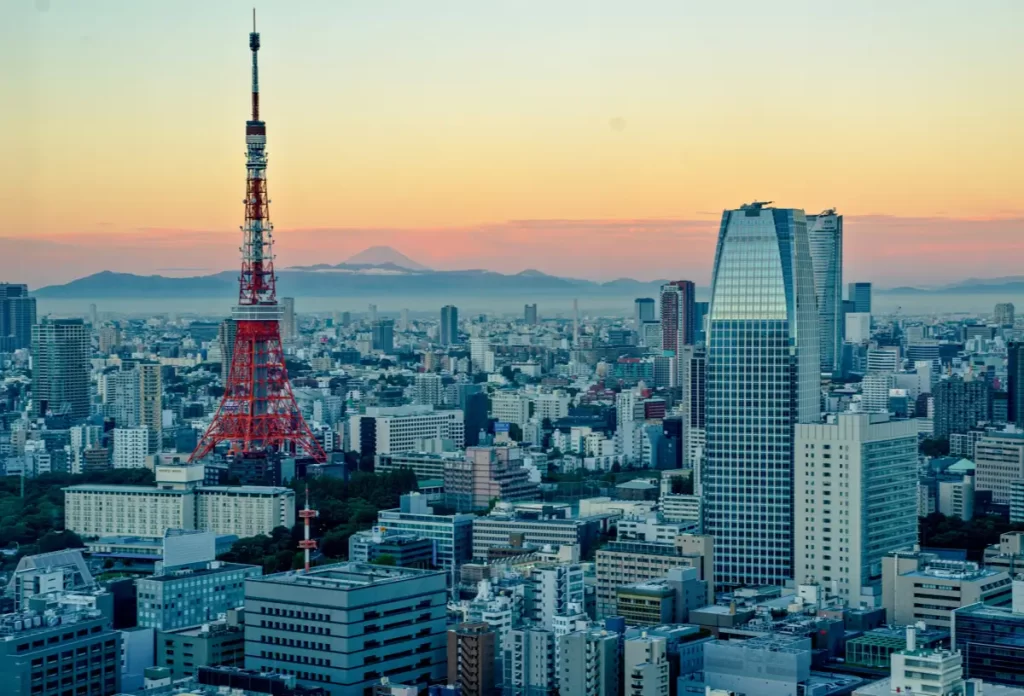
The best areas to stay in Tokyo first time are Shibuya, Shinjuku, Ginza, Chiyoda & Tokyo Station, Odaiba, Asakusa, Ueno, Shinbashi, Akihabara, and Roppongi.
Tokyo’s top areas each offer something unique: Shibuya and Shinjuku pulse with energy, shopping, and nightlife.
Ginza and Tokyo Station mix luxury with convenience.
And Asakusa and Ueno showcase the city’s traditional side.
Akihabara is a paradise for gamers and anime fans, while Roppongi brings international flair and nightlife.
Odaiba is futuristic and fun, and Shinbashi offers a taste of local, salaryman Tokyo.
Below, you find an overview of all the recommended areas along with a short explanation of what makes that area so special.
You can tap on the red link to go immediately to that recommended area. Or, simply continue reading the article.
Shibuya – One of the most popular areas for tourists, Shibuya is lively, youthful, and incredibly well-connected by train, perfect for exploring Tokyo. Plus, you’ll find plenty of sights and shopping just steps from your hotel.
Shinjuku – A classic Tokyo experience with buzzing nightlife, iconic skyscrapers, and easy access to the Yamanote Line. If you want to see Tokyo as it appears in movies, this is the place.
Ginza – Stylish and sophisticated, Ginza offers luxury hotels, upscale shopping, and a calmer vibe compared to Shibuya or Shinjuku. It’s a great base for travelers who prefer comfort and convenience without the crowds.
Chiyoda & Tokyo Station – Right in the heart of the city, this area is ideal for getting around—thanks to Tokyo Station’s unbeatable train connections. It’s modern, clean, and quiet at night, though not the place for nightlife.
Odaiba – This futuristic island is packed with fun attractions, shopping malls, and family-friendly activities—including Tokyo Disneyland nearby. Great for families, though it feels more theme park than traditional Tokyo.
Asakusa – Step into Tokyo’s past in Asakusa, where temples, street food, and traditional culture take center stage. It’s one of the best areas to experience old Tokyo charm.
Ueno – A relaxed, affordable area known for its massive park, museums, and a more local feel. It’s ideal if you’re looking for budget stays and easy sightseeing.
Shinbashi – A practical, central base with excellent train access. It’s more of a business district, but that means great izakayas and fewer tourists.
Akihabara – A paradise for gamers, anime lovers, and tech fans, Akihabara is colorful, quirky, and full of energy. It’s also well-connected for seeing the rest of Tokyo.
Roppongi – Famous for its nightlife and international crowd, Roppongi is packed with clubs, bars, and restaurants. It’s lively, modern, and a favorite among expats and partygoers.
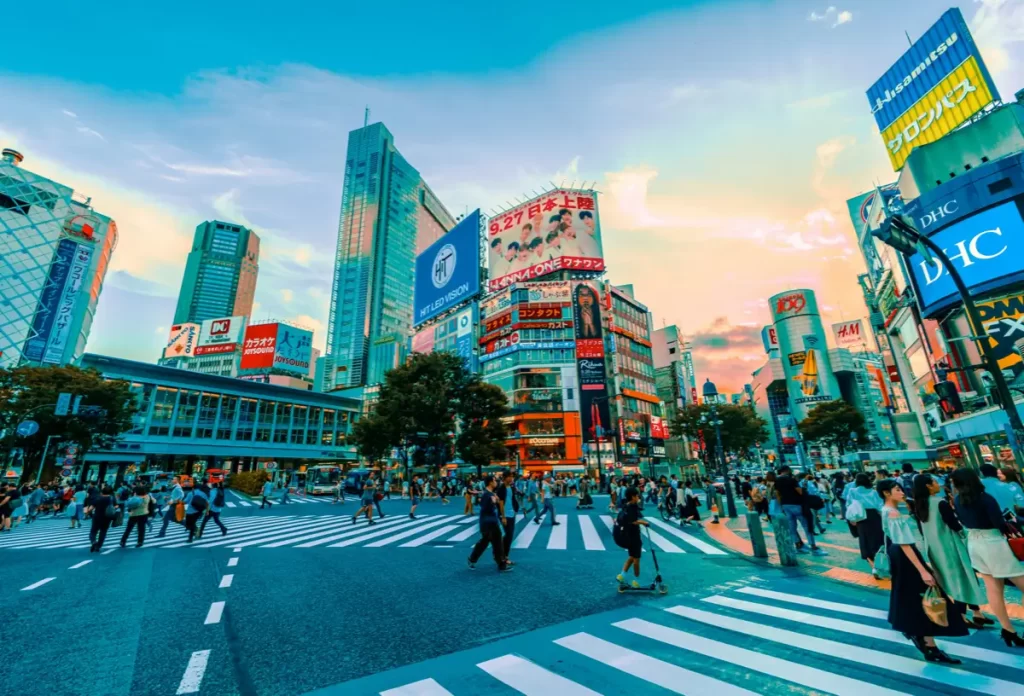
Shibuya is among the most popular area to stay in Tokyo among tourists for a few good reasons.
First of all, it has amazing access to several public transport lines.
From here, you can move to all corners of this enormous city without many problems.
For example, by simply taking the Tokyo-Metro Hanzomon Line, you go straight to the Tokyo Skytree.
Secondly, it’s a vibrant part of the city where you can find many restaurants, bars, and so-called izakaya.
There is an abundance of shopping possibilities as well.
Foodies should really get excited because Shibuya is known for its food scene.
Lastly, you have good access to some of the highlights of the city so make sure your batteries are charged because there is plenty of things to photograph.
For example, at Shibuya, you can find the busiest intersection in the world, the iconic Shibuya Crossing.
Those who have seen the movie Hachiko should definitely take a picture of the famous Hachiko Statue.
You have good access to some of the other city’s highlights, such as the Meiji Shrine and Yoyogi Park.
Because of these perks and the central location, Shibuya is often the first pick among sightseeing tourists.
For who: sightseeing tourists.
Advantages: amazing access to public transport, which is needed to explore Tokyo. Some highlights are already nearby.
Disadvantages: extremely crowded.


Like the previously recommended Shibuya, Shinjuku is also located on the west side of Tokyo, which is home to those futuristic buildings, large billboards, neon lights, huge department and electronic stores, and an abundance of restaurants the mind almost cannot comprehend.
This crazy part of Tokyo is something we’ve all seen in movies and many first-time travellers want to experience it themselves.
As you can find a great nightlife scene as well, it’s as desirable as Shibuya, especially among the younger visitors.
You have also access to the Yamanote Line, the most important transportation line and a must for tourists.
The majority of the travellers tend to stay at either Shinjuku or Shibuya, which both are excellent choices.
However, expect these areas to be extremely busy.
Those who visit Tokyo the traditional architecture and prefer an area less chaotic should pick one of the areas on the east side of Tokyo, which we will dive into further down this article.
But with city highlights like the Ghibli Museum, Samurai Museum, Tokyo Metropolitan Government Building and Shinjuku Gyoen Japanese Garden, great access to the trains, lots of shopping and nightlife, Shinjuku is perhaps the best option you have.
For who: younger travellers who want to experience the futuristic parts of Tokyo to the fullest.
Advantages: great nightlife, great access to public transport and the Yamanote Line, several city highlights nearby, Tokyo as seen in the movies.
Disadvantages: extremely crowded.
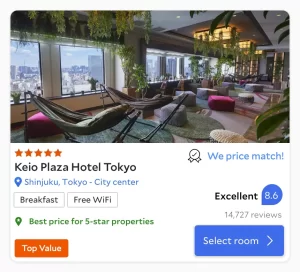
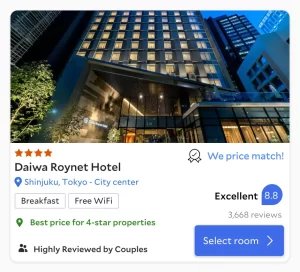
Ginza is yet another modern part of Tokyo, close to the important Tokyo Train Station, and is less busy than the previously recommended areas.
Especially during the evening, most of the larger crowds are gone.
A modern area like Ginza is provided with all comforts you want during your stay.
You’re located near a few main attractions.
On Sundays, the main road of Ginza is closed to traffic, which makes it even less chaotic.
The last thing that’s convenient is that Ginza is located right in the middle of the city, which makes it a perfect base to visit the main attractions that are spread over the city for the next few days.
Is there anything not to like?
Well, Ginza targets luxury travellers and citizens with a larger budget.
Expect to find top-notch hotels, shopping malls, high-end dining and a decent nightlife, although not as wild as the previous two recommended areas.
Now, you can find affordable hotels and it’s possible to dine and shop cheaply, but overall, expect to pay the premium price for the majority of the hospitality venues.
For who: luxury traveller.
Advantages: central location, top-notch hotels, high-end shopping malls, great base to explore Tokyo, far less busy than the previous two areas.
Disadvantages: expect to pay the premium price for a hotel room.
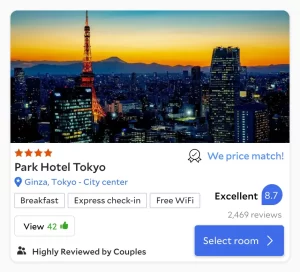

Right above the previously recommended area lies Tokyo Station, which plays a vital role when visiting Tokyo.
This is the main transportation hub in this insanely large city.
The train station is part of the earlier mentioned Yamanote Line, so if the area you choose is connected to this so-called Tokyo Loop Line, you can basically always reach Tokyo Station without much hassle.
But it’s pretty darn convenient to be located so centrally in Tokyo and also has direct access to the bullet trains, which you will most definitely use to explore other cities.
As you’re located near the Tokyo Imperial Palace, the Tsukiji Fish Market, Marunouchi (a popular business and shopping district), and Akihabara (known for its electronics stores, anime and manga shops, and gaming arcades), you can fairly say that Tokyo Station far from boring.
The previously recommended area of Ginza has that benefit too, but that area is more upscale than Tokyo Station, although quieter.
So, who will appreciate this area the most?
Those who do not want to stay in the popular, yet overly crowded areas of Shinjuku and Shibuya, or want to have the perfect base to explore Tokyo and other cities, right in the modern parts of Tokyo.
For who: those who want to take the most advantage of public transport and the bullet trains.
Advantages: the perfect base to explore Tokyo, located centrally, modern part of Tokyo.
Disadvantages: far less nightlife than the areas in the east.


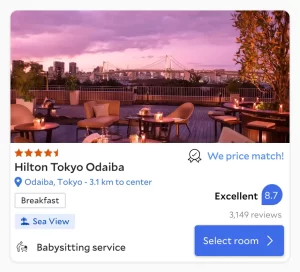
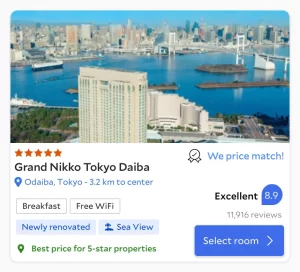
Odaiba is situated on a man-made island in Tokyo Bay, which offers stunning views of the city skyline and the Rainbow Bridge.
It doesn’t have any authentic vibe, but it’s a great way to escape the somewhat chaos of Tokyo.
On this man-made island, you can find several unique attractions that are linked by a monorail.
This area is known for the Rainbow Bridge and the replica of the Statue of Liberty.
It’s also home to Tokyo Disneyland.
When you combine all this, it’s a no-brainer that it’s one of the best areas to stay when visiting Tokyo with family.
Away from the hustle and bustle and with attractions like science museums, (theme) parks, and other child-friendly activities at your doorsteps, many families will find accommodation here.
For who: families.
Advantages: many interesting kid-friendly activities, home to Tokyo Disneyland.
Disadvantages: away from other major highlights, it doesn’t feel like Tokyo.
Asakusa is the old part of Tokyo that we mentioned before.
Here, you can find mainly low-rise residential buildings and you can find traditional architecture.
Culture and history lovers would most definitely love this area.
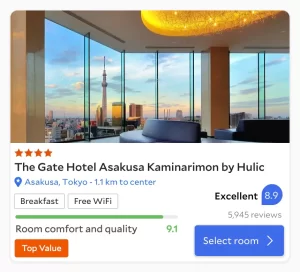
Right in the heart of Asakusa, you can find one of the major attractions of Tokyo, namely the Senso-Ji temple.
This famous temple dates back to the 7th century and is one of Tokyo’s oldest temples.
Asakusa also has a strong association with traditional Japanese culture, with a vibrant street market area called Nakamise-dori, where visitors can buy traditional Japanese souvenirs and snacks.
Especially if you want to escape the modernity that Tokyo also represents, it’s the perfect area to stay at.
Add the fact that you can find many affordable hotels in this part makes it even better.
But there are two things that you have to take into consideration.
First of all, there is no nightlife. For that, you have to travel to other parts of Tokyo.
This brings us to the second issue.
You don’t have direct access to the JR Yamanote Line.
You have to take the Ginza Line to Ginza where you can switch lines with this important loop.
This is about a ten-minute ride, but it’s good to know as we pointed out several times how important the JR Yamanote Line is.
For who: cultural and history lovers.
Advantage: staying in the older parts of Tokyo with rich cultural and historical significance.
Disadvantages: no nightlife, no direct access to the JR Yamanote Line.

Ueno is located west of the previously recommended Asakusa and is still part of the more traditional parts of Tokyo with low-rise buildings.
But this area, unfortunately, isn’t the most beautiful one.
However, it’s home to several important museums, including the Tokyo National Museum, the National Museum of Nature and Science, and the Shitamachi Museum.
Out of all the areas we’ve recommended, Ueno is the most peaceful one, which makes sense as it’s located quite a bit away from the hustle and bustle of the epicenter.
You have access to Ueno Park, which is a famous spot for hanami cherry blossom parties in Spring.
When you want to visit the center of Tokyo, you only have to take the JR Yamanote Line.
If you’re looking for a little bit of excitement, head over to Ameya Yokocho, which is a popular shopping street in this area where you can find plenty of shops, and souvenirs, but also a lot of local food.
If you’re looking for a wild adventure and exploring nightlife to the fullest, we have to disappoint you. Ueno is perfect for those who appreciate peacefulness.
Note: Ueno is among the most budget-friendly areas in Tokyo.
For who: those looking for a relatively quiet area in Tokyo
Advantages: great access to several important museums, access to Ueno Park, quiet area.
Disadvantages: it’s not as vibrant as other areas which some types of tourists appreciate but many won’t.

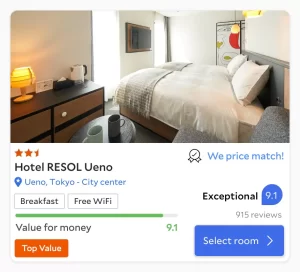
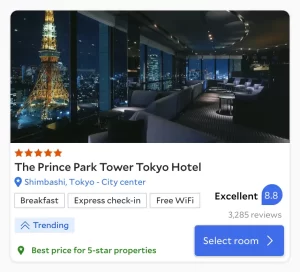
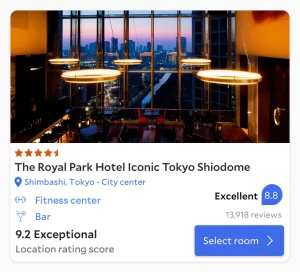
Shinbashi is located under the earlier-mentioned Ginza, which means that it’s located centrally in a modern area.
When it comes to location, Shinbashi is basically perfect.
This area is located in the heart of Tokyo, making it an excellent base for exploring the city.
It’s also close to several major train stations, including Tokyo Station, Shinagawa Station, and Shibuya Station, which makes it easy to get around the city and beyond.
You’re located close to several major attractions, including the Tokyo Tower. So far, so good.
There is only one thing.
Shinbashi is a business district and it’s an ideal area for workers to dine and drink after work at this particular area.
That means this area mostly caters to the citizens of Tokyo.
If you want to experience a night out with local businessmen, this is the place to be.
But other areas are far more suitable for tourists.
But the location and the connectivity of Shinbashi are simply perfect.
As you can expect from a business area, the hotels available here mostly cater to business people and individual travellers.
Expect high-quality single rooms, proper breakfast buffets and other good facilities.
For who: individual travellers, business travellers.
Advantages: central location in the heart of Tokyo, perfect access to public transport, ideal base to explore other parts of Tokyo.
Disadvantage: this area mainly targets business people, expect premium prices for a hotel room.
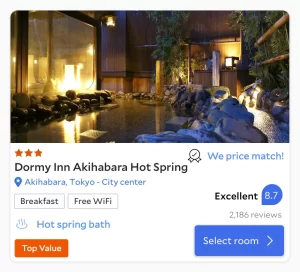
Akihabara is an area close to the older parts and right next to the earlier-mentioned Ueno.
It’s a small neighborhood with the nickname Neon Town that is known as the center of Japan’s otaku (geek) culture.
Visitors can find many anime and manga-related shops, such as comic book stores, figurine shops, and cosplay stores.
This is a great opportunity for first-time visitors to immerse themselves in Japan’s unique pop culture.
Akihabara is also famous for its numerous electronics shops, ranging from small specialty stores to large multi-story department stores.
Here, you can find a huge variety of electronics and gadgets, such as cameras, smartphones, video games, and so much more.
For those who are interested in technology, electronics, anime, manga, or cosplay, Akihabara is simply paradise.
As you can expect from such a unique area, there is quite a good nightlife scene available too and there is no shortage of delicious food.
Even if you’re not into one of these geek topics, a visit to Akihabara should be on your (bucket)list as things like cosplay, manga, and anime play such an important role in the Japanese culture among the younger generations.
But if you’re really into it, then definitely stay at the geek epicenter of Tokyo.
For who: those interested in manga, anime, and cosplay.
Advantages: geek epicenter of Tokyo, vibrant and unique area, good access to public transport to explore Tokyo.
Disadvantages: busy, if the geek topics are not your thing then stay elsewhere.

Roppongi is the area that attracts most foreigners and lies between the heart of the city and the popular western areas like Shibuya and Shinjuku.
So it has an excellent location in the modern parts of the city.
But as it’s so foreigner-orientated, it does lose a bit of authenticity and uniqueness.
But what attracts so many foreigners to stay (around) Roppongi?
It’s an area that attracts many foreign businessmen as there is an abundance of restaurants, bars, clubs and other types of entertainment venues, including adult entertainment.
And as this area is so foreigner-orientated, the staff at all these places speak English.
In other words, it’s an area full of comfort for the hedonistic traveller.
And we can’t deny that the nightlife scene here is excellent.
If you’re looking for more uniqueness, more authenticity and want to experience the true daily lives, whether it’s in the modern or older parts of Tokyo, then stay elsewhere.
But if you want to end your day of sightseeing with wild nights out in Japan’s capital, then Roppongi is one of your best options.
Just keep in mind that you don’t have direct access to the important JR Yamanote Line.
For who: hedonistic traveller.
Advantages: great nightlife scene, abundance of restaurants, bars, clubs and other entertainment venues, central location.
Disadvantages: it mainly attracts foreign businessmen and hedonistic travellers, no direct connection to the JR Yamanote Line.

